
Conventional productivity systems fail because they stress the importance of managing time while ignoring energy, motivation, attention, willpower, and adherence.
The reason for this shortcoming is that western thinking prefers to study variables that are easily measured in units (such as minutes and hours), while ignoring other holistic factors that are more difficult to track and scientifically prove.
My system takes a different approach: I believe that managing energy (and by extension — attention, focus, and willpower), is the key to hacking time and unleashing productivity.
I was introduced to this concept through the work of Tony Schwartz, founder of the Energy Institute and author of “The Power of Full Engagement.” The discovery of this idea has dramatically changed how I approach my work and my life.
The school of thought I’ve developed for peak productivity and hacking time initially begun with this idea. I took Schwartz’s revelation and expanded upon it a great deal through my own personal experiments.
And I’ve divided everything I’ve learnt into two frameworks for hacking time.
As I performed research for my book “Hack Sleep,” I studied countless medical research articles describing the function of the sleep and wakefulness centers of the brain and the exogenous cues that trigger or hinder the function of each.
Many people who write about productivity advocate things such as “harnessing the hour of power” (when attention and focus is at its peak), or trying the “pomodoro method” or some other such form of scheduling which incorporates periods of intense activity followed by rest.
While these make sense in theory, no one is actually able to scientifically prove what it actually is that regulates these cycles.
No one is digging beneath the veneer and catchy “hacks” to provide a roadmap of what, why, or how we have periods of intense productivity — and how to schedule our time accordingly.
Fortunately, we have such a map. Understand how this works, and you will win big.
Knowing how this cycle of renewing and expending energy operates is key to unleashing creative energy. And once you understand it, you’ll gain an unfair advantage.
The first cycle to understand is the “circadian rhythm.”
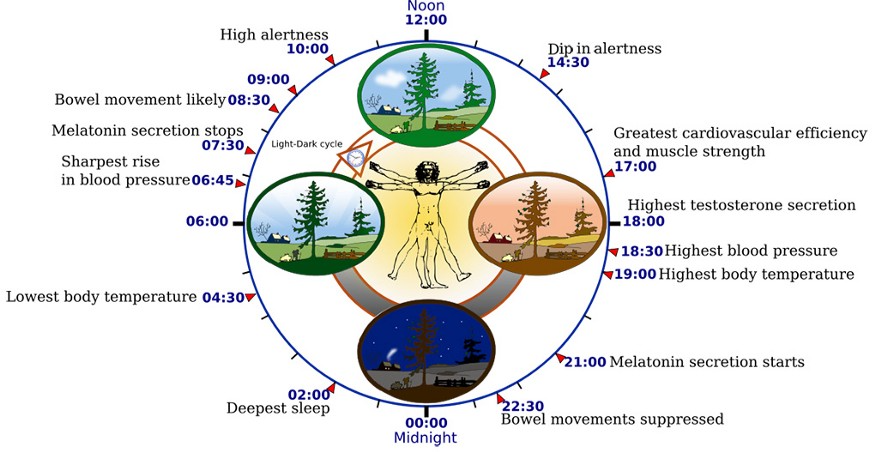
The circadian rhythm or circadian clock is a 24-hour cycle that regulates the most important functions that our bodies perform each day: our metabolism, immune system, cardiovascular system, reproductive system, and much more. It also affects our mood, health, and energy in all kinds of ways that most of us don’t realize.
The circadian rhythm is regulated by the cycle of light and dark. When light enters our eyes, certain functions begin. When we are exposed to light at nighttime, certain important functions are blocked and become more difficult to perform (such as sleep).
I came to understand this cycle intimately when I performed research for my book “Hack Sleep.”
From it I know:
• Levels of alertness peak in the mid-morning, at around 10:00am. This is also when our willpower is at its highest and the best time to “swallow the frog” and work on our highest-level tasks (such as writing and creative work).
• Exposure to light (especially direct sunlight) is extremely important to create serotonin in the brain, improving energy, mood, and sleeping habits. It is equally important to block out all exposure to light after sunset — use candles or dim lights in the home, and consider wearing light-dimming eyewear in the evenings if you live in a big city.
• Body temperature dips to its lowest daily point at 3:00pm, making early afternoons the most difficult time to work and the best time to nap.
• Two tablespoons of coconut oil can increase body temperature, unleashing greater levels of alertness, focus, and productivity. Cardiovascular exercise also increases body temperature.
• Eating pineapple in the evenings boosts melatonin production by 266%, improving sleep efficiency and quality.
Knowing how the circadian rhythm works, in my opinion, is a crucial edge for any creator. You can get your most important work done before others even finish their morning e-mail review.
You can also parlay this knowledge into even more competitive advantages, such as polyphasic sleep. I followed a polyphasic schedule for three months last year and my productivity shot through the roof.
During that time, I slept for four hours each night and took two 25 minute naps during the day, gaining an extra three hours, and keeping energy levels high throughout the day.
I don’t follow a polyphasic sleep schedule these days. But I do nap at the appropriate times, and I know when to capitalize on my most productive times and how to relax during the least productive periods. The circadian rhythm provides a model which makes my entire life easy and stress-free.
The ability to match the right type of work to the peaks and troughs in the circadian cycle is a force multiplier because you’ll be able to complete the most difficult jobs easily and save yourself from wasting time working on mundane activities at the wrong time.
Also — if it’s the end of the day and I’m tired, rather than start a hard task I’ll sometimes create an outline and notes so that I can start work on it tomorrow.
This helps make the difficult work easier to begin and complete and also starts our subconscious mind down the path we want well in advance.

This lesson is from the course “Hack Time: Achieve 10x More Through Godlike Efficiency and Speed“
Use the code “timehack#2023” for a 20% off at checkout.